DOG HEALTH > LARGE BREEDS > JOINTS AND MOBILITY
The Structural Reason Large Breed Dogs Break Down At Seven (And Why Every Medication Stops Working After A Few Weeks)
“He's a big dog. This is normal for the breed.” If your vet has said that to you more than twice, read this before you agree to another dose increase.
Fifth vet visit in six months.
Same room. Same questions. Same answers.
“How's Max going?”
“Not great. The carprofen stopped working again.”
“Right. Let's lift the dose. If that doesn't hold, we can add gabapentin.”
I nodded. Took the script. Walked out to the car and sat there for ten minutes before I could drive.
Because I had finally admitted something to myself.
They do not know how to fix this. They only know how to manage it.
Max is an eight year old Lab. Seventy one kilos of him, give or take.
His back legs had been going for the better part of a year, and every single visit ran the same script.
“It's arthritis. Pretty common in large breed dogs.”
“Let's try this.”
“Come back in a month and we'll see how he's travelling.”
And every time, the same thing happened. The medication worked for a few weeks.
Then it stopped. We lifted the dose. It worked again for a bit.
Then it stopped.
Max kept getting worse.
I am not angry at my vet. She is a good vet and she was doing what she was trained to do.
But after five visits, thousands of dollars, and a year of watching my dog struggle to stand up off the kitchen tiles, the best thing on offer was a higher dose.
That is not a solution. That is a subscription.

I Did the Maths on What “Managing It” Actually Cost
One night I sat down with the bank statements and added up nineteen months of managing my dog's joints.
- Consults, $95 to $110 a visit, fourteen visits
- Carprofen, roughly $78 a month
- A Cartrophen course, four injections, $340
- Gabapentin once the carprofen stopped holding, $46 a month
- Prescription joint diet, $142 a bag, and he goes through a bag a month
- A specialist referral and imaging, $890
Nineteen months. Just over $6,400.
And Max still could not get up off the floor without three tries.
Then came the sentence I was not ready for. A hip replacement, one side, quoted at fourteen thousand dollars.
Insurance would not touch it because it was pre existing.
I went home and cried. Then I got angry. Because there had to be something between spending fourteen thousand dollars and watching him give up.
What I Found at Two in the Morning
I am not a vet and I am not a scientist. But I can read, and I can think.
So I stopped searching for pain relief and started searching for something else entirely.
I searched for why large breed dogs fall apart so much faster than small ones.
And the answer was not what anyone had told me.
Here is the part that stopped me cold.
Large breed dogs do not lose collagen faster than small dogs.
“They lose it at roughly the same rate. Around seven to ten per cent a year after about age two.”
Dr. Katherine Mercer, Veterinary DermatologistThey lose it at roughly the same rate. Around seven to ten per cent a year after about age two.
Collagen is the structural protein. It is the framework in cartilage, in tendons, in ligaments.
It is what physically holds a joint together and lets it carry weight.
So if a Jack Russell and a Lab lose that framework at the same rate, why does only one of them fall apart?
Because the framework is not what changed.
The load did not change.

It Is Not Arthritis. It Is a Structure Carrying More Than It Can Hold.
A seven kilo dog loses half their collagen framework and their body absorbs it.
Seven kilos is not enough load to expose the weakness. They adapt.
They potter on to fifteen.
Max is seventy one kilos.
Every step he takes, every time he stands up off the floor, every jump into the back of the ute, that framework is carrying seventy one kilos.
By eight, he had lost close to half of it.
But he still weighed seventy one kilos.
So he was carrying a full load on a structure operating at roughly half capacity.
Year after year, thousands of times a day.
The maths does not work. The weight wins.
That is not bad luck. That is not genetics. That is not “normal for the breed.”
That is physics.
And once I understood that, the last two years suddenly made complete sense.
Why Every Single Medication Stopped Working After a Few Weeks
Look at what Max had actually been on.
Carprofen is an anti inflammatory. It reduces swelling and it takes the edge off pain.
It does not build cartilage and it does not strengthen a tendon.
Gabapentin blocks nerve pain signals. It never touches the joint at all.
Cartrophen supports the joint environment, and the research on it is best when it is used early, before the structure is already well gone.
Every one of them is designed to reduce inflammation or to interrupt pain.
Not one of them was ever designed to rebuild structure.
They were never meant to.
So for nineteen months I had been paying, every month, for products that were doing exactly what they say on the box, while the thing that was actually failing kept failing underneath.
That is why they worked for a few weeks and then stopped.
The relief was real. The decline never paused.
And it explains the pattern every large breed owner knows by heart.
Works. Fades. Increase the dose. Works. Fades. Add something new.
You are not going backwards because the medication is bad.
You are going backwards because the medication was never aimed at the problem.
Why the Supplements I Had Already Tried Failed Too
I had spent a fortune on the shelf at the pet shop. Joint chews.
Green lipped mussel. Fish oil. Turmeric. Glucosamine in three different brands.
If the label said mobility, it went in the trolley.
Here is what I did not understand at the time.
Most of them only address cartilage. Cartilage matters, but cartilage is the cushion.
It is not the thing carrying seventy one kilos. Tendons and ligaments carry the load, and they are built from Type I and Type III collagen.
Almost nothing on that shelf was aimed there.
Most of them are pills, powders or chews. Collagen in that form has to be broken down before a dog can use any of it, and the amount that survives the trip is small.
A liquid that is already broken into small peptides does not have that problem.
So the two things a big dog actually needs, the load bearing framework and the ability to absorb enough of it to matter, were the two things I had never once given him.

What I Went Looking For Instead
Once I knew what the problem actually was, the list of what to look for got very short.
- Type I and Type III collagen. The tendons and ligaments. The load bearing framework a heavy dog lives on.
- Type II collagen. The cartilage. The cushion inside the joint itself.
- MSM and hyaluronic acid. Support for a joint that is under constant mechanical stress rather than occasional stress.
- Liquid, not a pill or a chew. Pre broken into small peptides so a meaningful amount actually gets absorbed.
- Dosed for a dog over thirty kilos. Not a generic scoop written for a Cavoodle.
That is the entire list. It is not exotic. It is just aimed at the right thing.
I Asked My Vet Straight Out
At the next visit I asked her.
“Have you ever considered collagen for Max?”
She paused.
“There's research behind it. Especially for the big breeds.
But we usually start with medication.”
“Why?”
Another pause.
“That's just the standard protocol.”
Standard protocol. Not “because it works better.” Not “because it addresses the cause.”
Just standard protocol.
She was not hiding anything from me. She was trained in a system built to manage symptoms with prescriptions, because that is what a fifteen minute consult is designed to produce.
Nobody in that room was doing anything wrong. The room itself was pointed in the wrong direction.

What We Actually Did
I did not stop his medication cold. I talked to my vet first and we tapered him down slowly, and I would tell anyone reading this to do exactly the same thing.
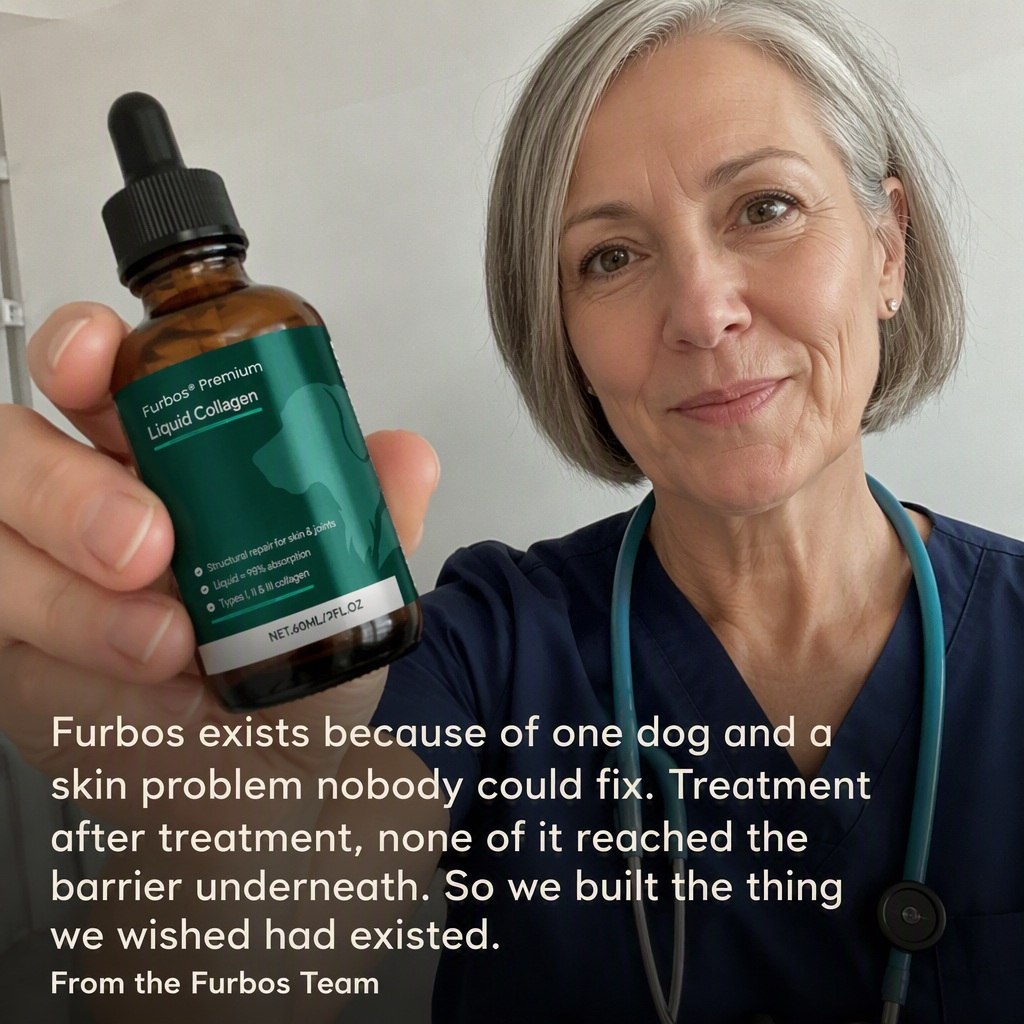
Then I started him on Furbos. Liquid collagen, all three types, with MSM and hyaluronic acid, in the dose for a big dog.
The whole ritual is one squeeze over his breakfast. That is it.
He has never once noticed it was there.
The first fortnight, nothing. I want to be honest about that, because it nearly beat me.
I had been burned by so many things that when week two came and went I assumed here we go again.
Week three was when it turned.
He stood up off the tiles in one go. Not three tries. One.
I stood in the kitchen and watched him do it twice more that day just to be sure I had not imagined it.
Where We Are Now
By week six he was getting up without bracing himself first, and we started stepping the carprofen down.
By week ten he was off it entirely, with the vet's blessing, and still improving.
By month four he was doing the full block again. Slowly, with a sit down halfway, but doing it.
At his last check she watched him walk across the room and said, “His mobility looks great.
What changed?”
“Collagen. That's all he's on.”
She nodded slowly. “The research on that for the big breeds is solid, actually.”
I did not say what I was thinking, which was, then why did I have to find it myself at two in the morning.
He is not a puppy. He is still eight. He still has bad days and he still has years of wear in those hips that no bottle undoes.
But he gets up. He comes to the door. He carries his lead around the house like an idiot when he hears the car keys.
I got my dog back.

If Your Vet Keeps Saying “It's Normal for the Breed”
They are not lying to you. It is common. Labs, Goldens, Shepherds, Rotties, Ridgebacks, Bull Arabs, the big working crosses.
Walk into any off leash park in the country and you will find half a dozen of them slowing down at six and seven years old while their owners try everything and watch it all fail.
But common is not the same as unavoidable, and it is definitely not the same as untreatable.
Big dogs are not scaled up small dogs. They are a structure under constant load that is losing framework every year while the load never drops.
Anti inflammatories do not touch that. Pain blockers do not touch that.
Cartilage only supplements do not touch that.
Rebuilding the framework does.
So if you have been told to lift the dose one more time, or that the only thing left is surgery you cannot afford, you are allowed to ask a different question.
Not “how do we manage this.” Ask “what is actually breaking, and can we rebuild it.”
Every month you wait, the framework gets a little thinner.
And it is far easier to rebuild it while there is still something there to build on.
What the load is doing to a big dog, year by year
Every one of these is about load, not age. A dog under ten kilos can lose exactly the same framework and never show it. The number that decides whether it shows is not how old he is. It is how much he weighs while it goes.
The three numbers that explain the last two years
50%
Of the joint framework is gone by about age eight
Collagen declines at roughly seven to ten per cent a year after age two in every dog, big or small. The difference is that a seven kilo dog never has to carry seventy on what is left.
0%
Of the common joint medications rebuild structure
Anti inflammatories reduce swelling. Pain medications interrupt signals. Both do exactly what they say. Neither was ever designed to rebuild a tendon or a ligament, which is why relief fades and the dose creeps up.
98%
Absorption from liquid collagen
Pre broken into small peptides. Pills, powders and chews absorb at only 20 to 30 per cent, which is why a big dog on a chew is getting a fraction of what the label promises.
What owners of big dogs tell us they saw
Other big dog owners in Australia


Dog Allergy Relief | Stop The Itching, Paw Licking And Yeasty Ears In 4 Weeks
Dog Allergy Relief | Stop The Itching, Paw Licking And Yeasty Ears In 4 Weeks
The daily liquid that rebuilds the collagen framework a big dog's weight has been grinding down since he was two.
🦴 Type I and III for the tendons and ligaments that actually carry the weight, plus Type II for cartilage.
💧 Liquid, pre broken into small peptides, so a 40kg dog absorbs a meaningful amount instead of 20 per cent of a chew.
🥚 One squeeze over breakfast. He will never know it is there.
BUNDLE AND SAVE
No se pudo cargar la disponibilidad de retiro
60 night money back guarantee
Australia Post Express, tracked
Bottled in Melbourne
Order in the next few hours and it leaves Sydney today. Tracked Australia Post Express. Get it between - and -.


Stop managing the collapse. Start rebuilding the structure.
Here is what to do. Tap the button below and check stock. Choose the pack that covers 8 to 12 weeks, because that is what a dog over 30kg needs to rebuild rather than to sample. Add one squeeze to breakfast every morning. Expect nothing for a fortnight. Watch for the one-go stand up around week three. Talk to your vet before you change anything he is already prescribed.
You have 60 nights. If nothing changes, email us and we refund you in full, even if the bottle is empty.
For your big dog,
Katie L.
Dog owner, Brisbane QLD
Furbos is a complementary supplement for animals. It is not a registered veterinary medicine and is not intended to diagnose, treat, cure or prevent any disease.
Never stop or change a medication your dog has been prescribed without speaking to your vet first.
Always consult a registered Australian veterinarian regarding your pet's health.